The Temperature Problem That Follows You Everywhere When You Travel
Travel has a temperature problem that no amount of itinerary planning fully prepares you for. It starts at the airport, where the departure hall is overcooled regardless of the season outside. It continues on the plane, where the air conditioning is calibrated for an average that doesn’t apply to any individual passenger. You land somewhere warmer, spend the afternoon comfortable in short sleeves, and then the evening drops fifteen degrees and you’re underdressed in a city where you don’t know where to buy a layer at 9pm.
This isn’t a planning failure. It’s the nature of travel: you’re moving through different thermal environments in the same day, and the clothing you packed for your destination doesn’t account for the environments you pass through to get there.
The conventional solution is to layer — to carry an extra sweater or a light jacket that bridges the temperature gaps. This works, but it has a cost. A sweater takes up meaningful bag space, adds weight, and has a specific thermal value that covers some environments and not others. The alternative — a compact wrap that folds to a fraction of the space and handles a wider range of conditions more precisely — solves the same problem with less overhead.
Where the temperature gaps actually occur
The temperature management problem in travel is less about the destination and more about the transit and the margins.
Airports are typically cold. They’re large, heavily air-conditioned spaces where you may spend two to four hours waiting. The temperature is set for the building’s thermal load, not for individual comfort, and it tends toward cold because the alternative — an overheated terminal full of people in travel clothing — is a worse outcome from a facility management standpoint. Sitting still in a cold terminal for three hours is a specific kind of uncomfortable that a thin wrap addresses directly.
Aircraft are colder still. Cabin temperatures on long-haul flights average around 20°C, which is comfortable when you’re moving but not when you’re seated and sleeping. The blankets provided are sized and constructed to minimum standards and vary considerably by airline and class. A long flight where you can’t sleep because you can’t get warm enough is a worse outcome than the weight of a wrap in your carry-on.
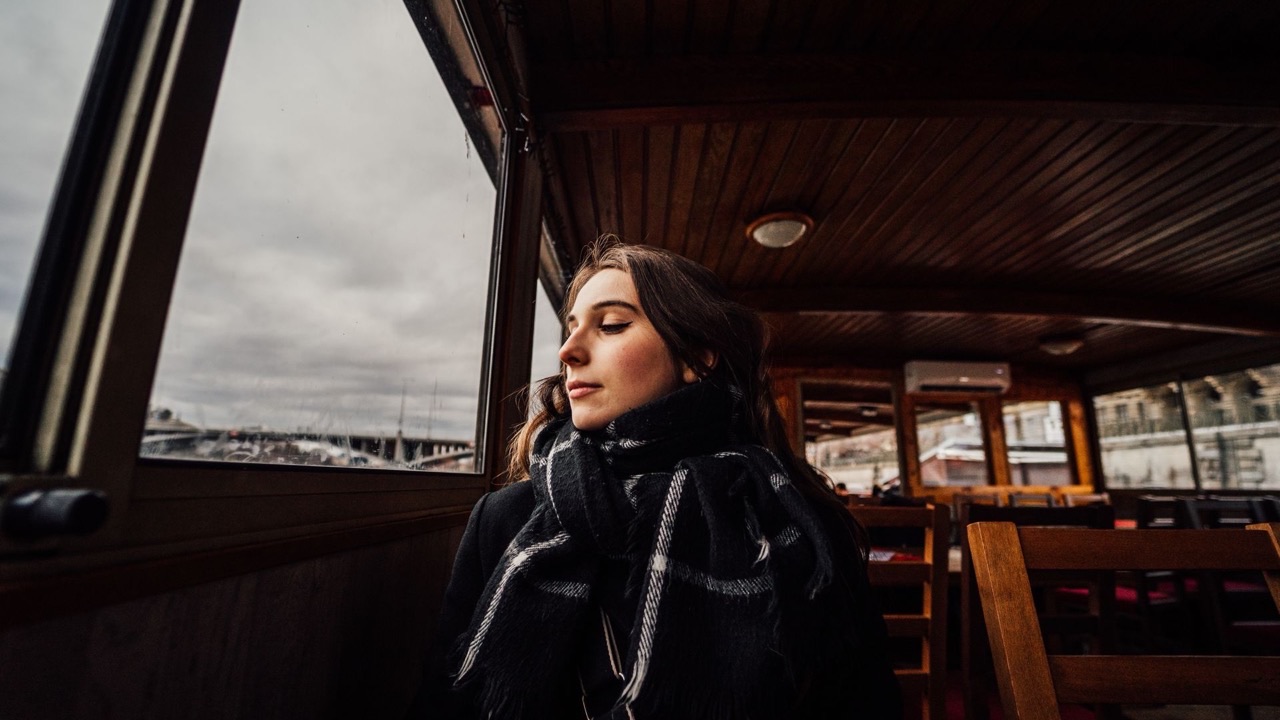
Ground transit — trains, buses, ferries — varies unpredictably. An air-conditioned train in summer can be significantly colder than a warm evening outside. A ferry crossing in autumn wind is a specific thermal challenge that neither the morning’s outfit nor the afternoon’s destination clothing handles well.
Evening outdoor settings are the most situational. Dinner on a terrace, a concert in an outdoor venue, a sunset at a viewpoint: all of these involve being stationary in ambient temperature that may have dropped considerably from the afternoon’s warmth. A wrap pulled over your shoulders in these settings is the difference between enjoying the evening and being distracted by cold.
Why a wrap works better than an extra layer of clothing
A sweater or jacket handles one thermal environment reasonably well. It’s the right amount of warmth for one temperature range, and too warm or insufficient for others.
A lightweight wrap is more adjustable. You pull it over your shoulders when you’re cold; you fold it in your lap when you’re warm; you drape it around yourself in a way that varies the coverage without removing and replacing a garment. On a plane, this means you can adjust continuously through a night flight’s temperature changes without waking yourself fully each time. At an outdoor dinner, it means you can add and remove coverage as the temperature drops and the wine warms you alternately.
The adjustability comes from the format — a wrap doesn’t have a fixed configuration the way a sweater does — and from the fiber. Lambswool with cashmere content responds to body temperature changes rather than maintaining a fixed thermal value. When you’re warmer, the fiber absorbs excess moisture and the effective warmth decreases slightly; when you’re cold, the natural insulation performs fully. This isn’t dramatic, but across a long flight or a variable evening it keeps the microclimate under the wrap more comfortable than synthetic alternatives that either trap or don’t insulate.
The packing case
The weight and volume of a lambswool-cashmere wrap are what make it a practical solution rather than an additional burden. At around 300–400 grams and compressed to roughly the size of a thick journal, it adds to a bag without meaningfully competing for space with clothing and other necessities.
The comparison to pack is not “wrap vs. nothing” but “wrap vs. extra sweater.” A wrap at 350 grams and compressed to 20×15 cm takes less space and weight than most knit sweaters, handles a wider range of temperature situations through its adjustable format, and has the additional advantage of being usable as a blanket — coverage that a sweater can’t provide.
It also handles the overnight plane scenario that an extra sweater doesn’t: a cashmere travel wrap laid over yourself as a blanket covers more surface area with less bulk than an equivalent sweater pulled on over clothes, and the natural fiber breathes through a six-hour flight without creating the clammy warmth that synthetic blankets accumulate.
The planning simplification
The way most people handle travel temperature uncertainty is to pack for a range — a light layer, a medium layer, a heavier option for cold evenings — and accept that they’ll carry some of it unused most of the time. This works but it’s inefficient: you’re carrying contingency weight that may never be used.
A wrap consolidates the cold-transit and cold-evening contingency into a single object. The airport, the plane, the cold-terrace dinner, the ferry crossing — all of these are the same object pulled from the same pocket of the bag. You’re not managing multiple contingency layers; you’re carrying one thing that handles the category of situations.
The temperature problem that follows you through travel doesn’t have a perfect solution, but it has a proportionate one. A wrap that takes up minimal space and handles the full range of transit and evening temperature situations covers most of what the problem actually involves.